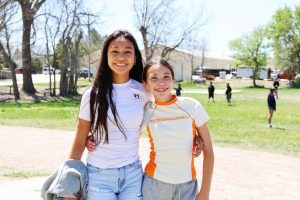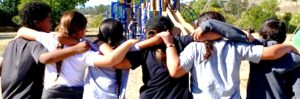
Maȟpíya Lúta Dual Language Immersion Program, Pine Ridge, South Dakota, works to revitalize the endangered Lakȟóta language by immersing students in their ancestral language and culture from early childhood through 12th grade, developing fluent speakers who are academically excellent and culturally grounded.
Vision and Mission
Maȟpíya Lúta (formerly Red Cloud Indian School, Inc.) traces its roots back over 135 years to Chief Red Cloud’s visionary efforts. Recognizing the irrevocable economic and cultural challenges facing the Oglala Lakȟóta people, Chief Red Cloud advocated for the establishment of “a school house – a large one” that would not only “teach us how to write and read, and instruct us how to do it” but also preserve and sustain Lakȟóta identity amidst a rapidly changing environment. After a decade-long lobbying effort, Chief Red Cloud succeeded, and in 1888, the Jesuits built a school on the Pine Ridge Reservation.
Today, Maȟpíya Lúta is powered by Lakȟóta people and Catholic Jesuits, encompassing four schools serving nearly 500 students, pastoral services reaching almost 800 families across reservation communities, and The Heritage Center—a cultural arts hub engaging with over 300 Native artists annually. Beyond its educational and cultural endeavors, Maȟpíya Lúta hosts transformative programs such as Truth and Healing, Food Sovereignty, Alumni and Graduate Support, and the Lakȟóta Language Center, reflecting a commitment to holistic community development rooted in the intersection of tradition and progress.
Maȟpíya Lúta believes that language is the living heartbeat of a people, and that a child who learns in their language and through their culture, grows in identity, confidence, and purpose. The Maȟpíya Lúta Dual Language Immersion Program exists to ensure that the Lakȟóta language not only survives but thrives. Our mission is to raise a generation of fluent speakers who are academically excellent, culturally grounded, and prepared to carry the language forward for generations to come. We are convinced that language revitalization is inseparable from educational excellence, and that every child deserves to learn in an environment where their heritage is not supplemental, it is foundational.
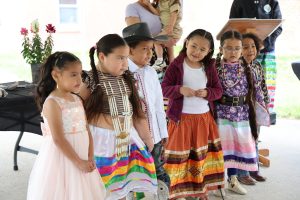
History
Early History “Maȟpíya Lúta (formerly Red Cloud Indian School, Inc.) traces its roots back over 135 years to Chief Red Cloud’s visionary efforts. Recognizing the irrevocable economic and cultural challenges facing the Oglala Lakȟóta people, Chief Red Cloud advocated for the establishment of “a school house – a large one” that would not only “teach us how to write and read, and instruct us how to do it” but also preserve and sustain Lakȟóta identity amidst a rapidly changing environment. After a decade-long lobbying effort, Chief Red Cloud succeeded, and in 1888, the Jesuits built a school on the Pine Ridge Reservation.
Today, Maȟpíya Lúta is powered by Lakȟóta people and Catholic Jesuits, encompassing four schools serving nearly 500 students, pastoral services reaching almost 800 families across reservation communities, and The Heritage Center—a cultural arts hub engaging with over 300 Native artists annually. Beyond its educational and cultural endeavors, Maȟpíya Lúta hosts transformative programs such as Truth and Healing, Food Sovereignty, Alumni and Graduate Support, and the Lakȟóta Language Center, reflecting a commitment to holistic community development rooted in the intersection of tradition and progress.”( Maȟpíya Lúta website)
Current History The Maȟpíya Lúta Dual Language Immersion Program was founded in response to a sobering reality: the Lakȟóta language is endangered, with fluent elders aging and the number of young speakers in serious decline. Maȟpíya Lúta was established to reverse that trend through immersive, evidence-based education that places language and culture at the center of every learning experience. What began as a commitment to early childhood language learning has grown into a comprehensive K,12 program serving students, families, and the broader community
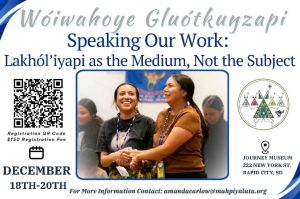
. Over the years, the program has developed a complete leveled reader library in Lakȟóta, trained staff as photographers to produce community-based, culturally authentic materials, published collections of historical and traditional texts, and hosted the annual Wóiwahoye Gluótkuŋzapi Lakota Language Education Conference, a regional gathering that brings together educators, families, elders, and students as co-learners and co-contributors. In recognition of the program’s sustained impact and potential for replication.
To achieve this, the program operates at every level of the school community. Curriculum development is guided by WWC ( ) evidence-based strategies, including a leveled reader framework that ensures students at every stage of their language journey have access to texts that challenge and affirm them. Professional development supports educators through structured, research-grounded training that builds immersion instructional practice. Family and community engagement are woven throughout, rooted in the belief that language is passed through relationships, between elders and youth, between families and schools, between generations.
Students face real risks when language and cultural identity are lost, including disconnection, diminished academic confidence, and the erosion of community cohesion. The Dual Language Immersion Program addresses these risks directly by giving students not only a language, but a foundation.
Program Description
The Maȟpíya Lúta Dual Language Immersion Program helps students develop fluency in Lakȟóta while achieving academic excellence across all content areas. Students are immersed in the language from the earliest grades, developing not only linguistic proficiency but a deep connection to Lakȟóta history, values, and ways of knowing. The program is built on the understanding that language revitalization cannot happen in isolation, it must permeate school life, reach into families and communities, and be supported by well-trained educators who are themselves learners and speakers.
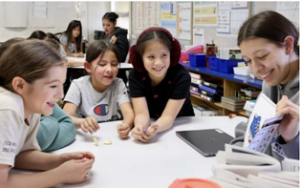
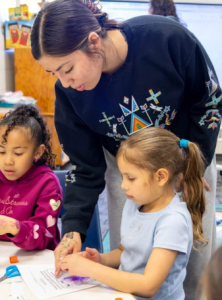
To achieve this, the program operates at every level of the school community. Curriculum development is guided by WWC evidence-based strategies, including a leveled reader framework that ensures students at every stage of their language journey have access to texts that challenge and affirm them. Professional development supports educators through structured, research-grounded training that builds immersion instructional practice. Family and community engagement are woven throughout, rooted in the belief that language is passed through relationships, between elders and youth, between families and schools, between generations.
Students face real risks when language and cultural identity are lost, including disconnection, diminished academic confidence, and the erosion of community cohesion. The Dual Language Immersion Program addresses these risks directly by giving students not only a language, but a foundation.
Activities: Together, these activities create a continuous, community-wide language environment in which students, families, and educators grow as speakers side by side.
The program’s core activities span instruction, curriculum, professional development, and community engagement. Classroom immersion takes place daily across all grade levels, with instruction delivered in Lakȟóta through content-integrated lessons aligned to academic standards.
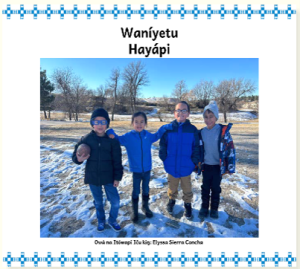
The leveled reader library, developed and illustrated in-house using community photography and local illustration, supports reading growth from beginning through advanced levels.
K-8 Elementary immersion Dual Immersion Program: One of our significant achievements is the introduction of the Lakȟóta Dual Immersion Program. In 2019, we launched the first Lakȟóta Dual Immersion Class for kindergarten students, where subjects are predominantly taught in Lakȟóta, with some instruction in English. Today, our students are fully immersed in Lakȟóta from kindergarten to fifth grade, and we are actively working towards expanding the program to higher grades. The results have been remarkable – even after just a few months of instruction, some of our kindergarten students are already reading and completing their schoolwork in Lakȟóta.
Through the Lakȟóta Dual Immersion Program and our comprehensive curriculum, we are fostering a deeper connection between our students and their culture and spiritual identity. This connection not only enhances their academic outcomes but also instills a sense of pride and belonging.
Secondary Program: A high school dual immersion cohort model extends advanced language learning opportunities to older students, including immersion simulations and real-world language application.
Wóiwahoye Gluótkuŋzapi Podcast Maȟpíya Lúta Owáyawa students have created an all Lakota language podcast. We are two episodes in and will be releasing new episodes every Monday. I have included the link to the Wóiwahoye Gluótkuŋzapi Podcast via apple podcast and the first two episodes. The podcast can be found on most podcast apps/sites, not just apple podcast.
Early Childhood Program The Early Childhood Learning Center (ECLC) is dedicated to educating our youngesttribal members in a high quality early childhood Lakota immersion setting bringing parents and community together for the revitalization of our language, values and traditions. We create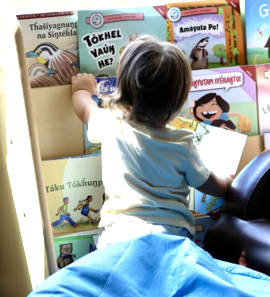 learning environments that respect each child, their skills and abilities, and honor their heritage with hands-on experiences that are shared directly with parents and caregivers. Our sacred children possess the capacity for dual language that will preserve and strengthen our Lakota Oyate.
Resources:
Early Childhood Learning Center Policy Book prepared for Parents/Guardians created by the ECLC staff
Lakota for Early Readers: “You can support readers at home bu learning together just a few minutes eachd day. Here are some resources to use as you practice.”
Professional development
Educator development follows a structured professional development pathway, including NABE literacy badges (……) and individualized growth plans.
Each year, the Wóiwahoye Gluótkuŋzapi Lakota Language Education Conference brings together hundreds of community members for a multi-day, language-rich immersion experience featuring keynote speakers, hands-on sessions in traditional arts, curriculum workshops, and intergenerational conversation.
Family engagement
Resources for Families Please use these resources to support learning at home and contact us with any questions or concerns.
Infor rmation online for families to support Dual Language Reading Resources Reading with you child in any language is so important for language development!
Example: When reading together with your child in any language:
-
-
- Ask them to retell the story using words like first, then, finally.
- Ask them to describe the setting.
- Ask them to identify the problem and solution.
- Set time aside for your child to read to you in Lakȟota.
-
Community: The broader community is actively involved in maintaining and preserving Lakota language and culture.
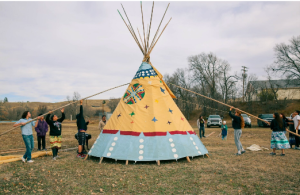
The Chatku Arts Center steps into living history, culture, and community. Display, guided tours and stories rovide deeper understanding of the people, traditions, and history . that shape the community. An Art Showtakes place for ten weeks each summer. All the artwork is for sale, with the proceeds used to support individual artists as well as the work of the Čhatkú Arts Center. The gift shop features the art of over 300 Native Artists, a renowned Native art collection containing nearly 13,000 pieces, a gallery hosting 2-3 exhibits a year, the annual art show, and much more.
Audiences Served
The Maȟpíya Lúta Dual Language Immersion Program serves a wide and interconnected community. At its center are students from early childhood through 12th grade, many of whom are Lakȟóta descendants reconnecting with their ancestral language.
Children : preschool to grade 12
Educators, including classroom teachers, language specialists, and administrators. participate as active learners and practitioners.
Families are engaged as essential partners in the language journey
Elders serve as cultural anchors and knowledge holders. Through the annual conference and community materials, the program also reaches a broader regional audience of Indigenous educators, language advocates, and tribal communities across the Great Plains.
Successful Impact The program’s impact is visible across multiple dimensions of school and community life. Students in the immersion program demonstrate strong academic performance alongside growing Lakȟóta language proficiency.
- 500 K-12 students in two elementary schools, one middle school and one college-prep high school.
- 800 Families served through pastoral programming across multiple communities on the Pine Ridge Reservation.
- The leveled reader library has provided hundreds of students with culturally grounded, language-appropriate texts where none previously existed.
- Educator confidence and instructional capacity have grown through structured professional development, with staff earning NABE literacy credentials and developing individualized growth plans.
- The annual Wóiwahoye Gluótkuŋzapi Conference has become a regional touchstone, drawing hundreds of attendees each year and strengthening connections between schools, families, and tribal communities.
- 300 Native Artists in collaboration with The Heritage Center through the Art Show, gift shop and exhibits.
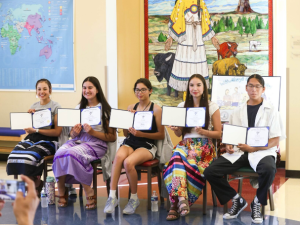
- Most meaningfully, students and families report a deepened sense of cultural identity and belonging — the foundation the program was built to provide. This sense of pride has translated into tangible academic recognition as well: Maȟpíya Lúta High School students have begun earning the State Seal of Biliteracy for proficiency in Lakȟóta — the first students in South Dakota to receive this recognition for their ancestral language. Introduced by the South Dakota Department of Education to celebrate mastery of multiple languages, the Seal is permanently noted on graduates’ academic transcripts and displayed on their diplomas.
- What began with a pioneering cohort has continued to grow, with more students earning the distinction each year — validating that Lakȟóta fluency is a rigorous, measurable, and celebrated academic achievement.
Recommendations for Replication and Adaptation Communities and schools exploring Indigenous language immersion programs are encouraged to consider the following lessons from Maȟpíya Lúta’s experience:
- Start with relationship, not curriculum. Before building materials or writing lesson plans, invest in relationships with elders, families, and community members. Their knowledge, trust, and participation are irreplaceable — and cannot be retrofitted later.
- Build your own materials from the start. Commercially available materials rarely reflect Indigenous languages or communities authentically. Training staff to create locally developed, community-photographed leveled readers ensures cultural accuracy and builds long-term capacity within your own school.
- Treat educator development as ongoing, not one-time. Immersion teaching is a specialized practice. Maȟpíya Lúta uses structured professional development pathways, including NABE literacy badges and individualized growth plans, to support teachers as learners alongside their students.
- Plan for K–12 continuity from the beginning. Language fluency develops over years. Programs that begin in early childhood without a plan for upper grades lose momentum. Design with the full arc in mind, even if you build it incrementally.
- Make the language visible schoolwide, not just in one classroom. Signage, announcements, events, and daily routines in the target language reinforce immersion beyond the instructional hour. Language revitalization requires an environment, not just a class period.
- Create regular community touchpoints beyond the school day. Language revitalization thrives when it extends into family and community life. Cultural family nights, adult language classes, and community celebrations create low-pressure opportunities for families to engage with the language alongside their children. These events build community, support parents and caregivers in their own language journeys, and reinforce that Lakȟóta is a living language — spoken at home, at gatherings, and across generations, not only in the classroom.
- Include a community event as a programmatic anchor. The annual conference model creates accountability, celebration, and cross-community learning. Even a smaller-scale gathering can energize families, affirm students, and attract regional partners.
- Network with other Indigenous language revitalization communities. Some of the most valuable learning comes not from academic research but from communities who have walked this path before. Maȟpíya Lúta has built meaningful partnerships with language immersion programs in Hawaiʻi and New Zealand, drawing on their decades of experience with Indigenous language revitalization at scale. These relationships have shaped curriculum thinking, immersion methodology, and long-term program vision in ways no textbook could. Seek out these connections early — the global network of Indigenous language educators is generous, and the parallels across communities are striking.
For more information, training guidance, or consultation, contact the Maȟpíya Lúta Language Center directly. Staff are available to share resources, discuss implementation, and support adaptation for your community’s context.
Contact
Website: www.mahpiyaluta.org
Amanda Carlow, Language Center Director: amandacarlow@mahpiyaluta.org