
 Wings of Freedom
Wings of Freedom (WOF) is a holistic after-school and summer tutoring program serving marginalized students ages 10–15 across six grade levels in Egypt and Guatemala.
Vision
Wings of Freedom is based on the belief that children growing up in poverty deserve the same quality of educational support as anyone else, and that academic instruction alone is not enough to deliver it. A child who cannot see the board, who has no trusted adult to talk to, or whose family is in financial crisis will not benefit from tutoring alone. WOF addresses the whole child and the whole family, because that is what it takes.
“It is easier to build strong children than to repair broken adults.” — Frederick Douglass
Mission
Wings of Freedom (WOF) is a holistic after-school and summer tutoring program serving marginalized students ages 10–15 across six grade levels in El Khosous, Egypt (est. 2020) and San Lorenzo El Cubo, Guatemala (est. 2023). The program delivers academic instruction, complemented by digital literacy training, mandatory health and vision screenings, dedicated social worker support for every enrolled student, and monthly parent engagement workshops. Unlike traditional tutoring centers, Wings of Freedom integrates academic, psychological, health, and economic dimensions into a single coordinated model.
The program was created in response to a growing educational crisis in underserved communities where children are not simply falling behind academically but are being systematically excluded from long-term opportunity. In El Khosous, Egypt, overcrowded classrooms, under-resourced schools, and dependence on costly private tutoring have made quality education inaccessible for low-income families. For families living on $1 to $2 per day, these costs are impossible to sustain. As students fall behind, many disengage from school entirely, and pathways to higher education and stable employment become increasingly limited.
In San Lorenzo El Cubo, Guatemala, the barriers are different, but the outcome is the same. Families in this rural agricultural community survive on unstable daily wages, and many children leave school early to contribute financially through labor. Students complete an average of only four years of formal education, and fewer than 30% graduate from sixth grade. Rural and indigenous youth consistently receive less schooling than their urban peers, limiting access to future employment and economic mobility.
History
Wings of Freedom is one of the major projects of Finding Freedom through Friendship, Inc. (FFF). It was established in 2009 with a commitment to the holistic transformation of women, youth, and children living in areas of endemic deprivation. Beginning with a single program in Guatemala, FFF expanded to Egypt in 2017 and today operates six integrated programs across five countries, reaching more than 39,000 individuals since inception. Alongside its tutoring work, FFF addresses the full spectrum of need through its Widow Program (healthcare, nutrition, housing, and children’s education), Scholarship Program (college and private school access), Community Development Centers (vocational training and microloans), Microfinance Program (below-market loans for underserved entrepreneurs), and Community Health & Humanitarian Relief (free health screenings and disaster response). This interconnected model reflects FFF’s conviction that lasting transformation requires meeting individuals at every point of vulnerability.
In April 2020, Wings of Freedom launched in El Khosous, Egypt, a large slum area north of Cairo with a high concentration of marginalized children lacking access to quality education. The program was launched during the global pandemic and immediately demonstrated its value by addressing urgent educational and social needs in a community where public-school dropout rates exceed 30%.
In February 2023, FFF responded directly to the need in San Lorenzo El Cubo, Guatemala, a community of agricultural workers earning meager daily wages, expanding Wings of Freedom there with confidence in the model’s ability to translate across distinct cultural, linguistic, and economic contexts. The expansion validated both the program’s adaptability and FFF’s capacity to replicate documented results where they are needed most.
Activities
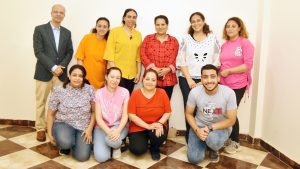 Wings of Freedom Staff
Students:
Academic Tutoring After public school ends, students come to the WOF center for three hours of tutoring, five days a week. Small groups of 8 to 12 students work through Egypt’s six national curriculum subjects with teachers who specialize in their subject area and are hired from the local community. There are no fees or scholarship costs associated with our tutoring programs.
-
- National Exam Preparation: The focus on preparing students for mandatory government exams required for grade advancement
- Subjects: Arabic, English, mathematics, science, social studies, and computers.
- Assessments: Every student is tested at the start and end of each cycle so progress is tracked against their own baseline, not compared to a class average.
- Individualized Learning Plans: Customized academic support based on pre-assessment testing
Special Education In 2024, WOF opened a dedicated special education classroom. Students who need more individualized support than the standard group setting can get one-on-one and small-group instruction, plus speech therapy.
-
- How students are identified: Through intake assessments, social worker observation, and the health screenings done at enrollment.
- Progress: Reviewed quarterly for every student in the classroom.
- The goal: Students work in the special education setting until they are ready to join their regular grade group, then transition with continued social worker support.
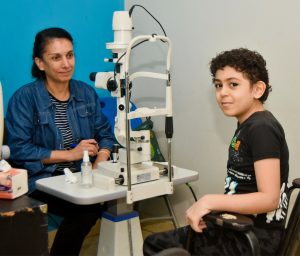
Health Screenings Before the school year starts, every enrolled student gets a full health screening. Screenings are also open to parents and siblings. If a student needs follow-up care, WOF connects them to a specialist and covers costs where needed.
-
- What is covered: Physical exam, blood work, vision, dental, and hearing.
- Eyeglasses: Students who need vision correction get prescription glasses at no cost.
- Health education: Social workers run workshops throughout the year on hygiene, nutrition, reproductive health, and substance abuse prevention.
- Records: Medical records are kept on file for every student.
Social Worker Support Every student has their own social worker. Caseloads are kept to five or six students on purpose, so the work can actually be done well. Social workers meet one-on-one with their students every week, make regular home visits, write monthly progress reports, and stay in close contact with teachers.
-
- KSA: A trauma-informed counseling framework introduced in December 2022, run twice monthly in separate tracks for social workers, students, and mothers.
- MESARPAC: A structured approach for working through abuse-related trauma, used alongside KSA.
- Professional development: Social workers attend at least one conference, workshop, or training course per year.
The kids in this program have often experienced violence, neglect, abuse, and chronic stress. For many of them, their social worker is the most consistent, trusted adult in their life. That relationship is what holds the rest of the program together.
Additional Activities:
Enrichment
-
- Sports: During summer, the program runs sports two days a week, four hours a day, with 30 or more students. Football is the main activity.
- Field Tri: Social workers organize full-day trips open to students, staff, and siblings, with lunch included. Past destinations: Wonderland Amusement Park, Space Museum and Adventure, Nemo Farm, A Pottery Factory, The Children’s Museum for Civilization and Creativity
- Art, Music, and Theatre: Art, drawing, music, and theatre are part of both the summer schedule and the regular school year enrichment program. They are run by social workers and staff, not separated standalone activities, so creative expression is fully integrated.
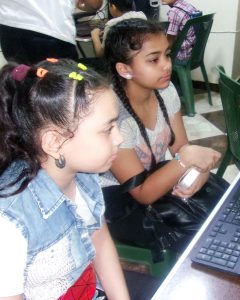
Summer Camp Computer Program
Family Engagement Before a student enrolls, a parent or guardian signs a commitment agreement. Participation is not optional. The program tracks family engagement every month, alongside each student’s academic and social-emotional data, because what happens at home directly affects what happens in the classroom.
-
- Monthly workshops: All families attend sessions on child development, positive parenting, trauma identification, and conflict resolution.
- Weekly individual sessions: Social workers meet separately with mothers each week to go over their child’s progress and talk through anything happening at home.
- Home visits: Regular visits keep the relationship going outside the center.
Economic Empowerment Launched in 2024, the program works with mothers of enrolled students to help them start or grow a small business before financial crisis’ hits.
-
- Each mother gets a one-on-one vocational assessment to figure out the right business fit, and then receives training in production, sales, pricing, and customer service.
- Common training areas: Cosmetics, nail and hair services, sewing, and baking.
- Businesses launched: Wedding accessory production, slipper vending, kiosks, nail and hair salons.
- Microloans: $60 to $140 at 5% interest. Local banks charge 20% to 40%.
- 2025 results: 33 women supported, 100% repayment rate, 50+ women on the waiting list for 2026.
Audience/s served Wings of Freedom serves multiple interconnected audiences:
Students Currently, 150 students are enrolled annually across both centers. Each student receives individualized attention from qualified teachers and dedicated social workers (approximately 5–6 students per social worker), comprehensive health screenings, and enrichment activities. Students with special learning needs receive tailored instruction in dedicated classrooms.
Parents and Families Wings of Freedom actively engages parents, particularly mothers, through mandatory monthly workshops addressing child development, positive parenting, trauma identification, and conflict resolution. Parents receive vocational skill training and access to low-interest microloans to launch or expand small businesses. To date, 30% of parents have successfully established income-generating enterprises, directly improving household economic stability.
Teachers All teachers are graduates of Faculties of Education and hold degrees in their respective areas of specialization. In addition to their academic qualifications, they have at least 5 years of teaching experience and are currently employed in government schools.
Teacher recruitment is conducted through recommendations from school principals and experienced educators to ensure candidates meet the program’s educational and professional standards. Applicants participate in interviews and complete a trial period of approximately one month before final selection.
Teacher performance is evaluated regularly through:s tudent monthly assessments and progress reviews; classroom observations by educational center staff; and ongoing evaluations by supervisors and administrators.
Professional Staff and Community Wings of Freedom employs local professionals across both centers, including qualified subject teachers, licensed social workers, educational counselors, program administrators, and health coordinators. Staff receive ongoing professional development through monthly workshops addressing trauma-informed practices, behavioral interventions, and effective teaching methodologies. This investment in local capacity building ensures program sustainability while developing civic awareness and community leadership.
Successful impact
Wings of Freedom has served over 500 students since launching in Egypt in 2020. The program’s most meaningful milestone came in 2025, when the first graduating cohort completed the full six-year cycle. Sixteen students finished the program. Fifteen of them continued into higher education.
Irini Samsam Rushdi was one of them. She arrived at Wings of Freedom unable to keep up in school, managing Bell’s palsy, and feeling, in her own words, that no one saw her. Her social worker stayed with her through individual speech therapy and specialized instruction until she found her footing. By the time she graduated, she was reading independently, speaking with confidence, and hoping to become a doctor. “Wings of Freedom gave me more than help with school,” she said. “They gave me the wings to believe in myself.” Her story is what the program is designed to produce.
Academic Excellence
-
- Students consistently pass the national exams required for grade advancement, at rates well above what the public school system delivers in these communities.
- 3% dropouts since 2020
- 94% of the first graduating class (2025) pursued higher education
- Most students show measurable improvement across core subjects based on pre- and post-assessments administered each cycle.
- All students receive digital literacy training covering internet safety, research skills, and educational software, even though this falls outside the standard national curriculum.
Holistic Student Development
-
- Every student is assigned a dedicated social worker who meets with them individually each week, makes regular home visits, and stays in close contact with their teachers.
- Every student receives a full health screening before the academic year covering physical, blood, vision, dental, and hearing assessments. Many arrive needing corrective eyeglasses that were never identified by the public school system. WOF covers the cost.
- Students, parents, and staff are honored with gifts, clothing, and recognition during national holidays and graduations, strengthening community bonds.
Family and Community Impact
-
- Family engagement is built into enrollment from day one. Parents attend monthly workshops and meet weekly with their child’s social worker, because what happens at home directly affects what happens in the classroom.
- Parents attend monthly workshops on child development, trauma recovery, and positive parenting, alongside weekly individual sessions with their child’s social worker.
- The microloan program connects mothers to startup capital and business training so that household financial stability does not become the reason a child leaves school.
- Local professionals are employed, strengthening community capacity and civic engagement.
- Consistent enrollment growth has driven staff expansion, including teachers, social workers, and support personnel.
Recommendations for replication and/or adaptation
The Wings of Freedom model has been replicated from Egypt to Guatemala and is designed to be transferable. FFF’s leadership CEO Jody Greenlee, Middle East Director, CFO Marguerite Doyle, and program managers with decades of combined experience in education, social services, and international development can provide technical assistance to organizations seeking to replicate or adapt the Wings of Freedom model. FFF is committed to sharing its program documentation, tools, and lessons learned to support the growth of high-quality education programs serving marginalized communities globally.
The following principles reflect what has proven essential in practice.
1.Start with the Right Local Partner: For example, WOF is delivered in Egypt through CSD, the Council of Services and Development, a division of the Synod of the Nile. That partnership gave the program immediate credibility with families, churches, and community networks that took years to build.
-
- Identify a trusted local partner before designing any programming.
- Let that partner lead community outreach, student recruitment, and stakeholder relationships from the start.
- Do not attempt to build community trust from scratch. Partner with an organization that already has it.
- Hire Local Staff and Invest in Them: Every teacher, social worker, and administrator in the WOF program is a member of the community. They know the families, speak the language, and are present in ways outside staff cannot be.
-
- Hire from within the community wherever possible.
- Social workers participate in structured training twice monthly, attend annual conferences, and receive formal recognition and bonuses.
- Treat social work as a profession, not a volunteer commitment. Retention in high-demand, emotionally intensive roles depends on it.
- Build the Social Work Component Before Scaling Enrollment
The social work component is what separates WOF from a standard tutoring center. It is also what keeps students enrolled when household crises would otherwise pull them out.
-
- Hold caseloads to five or six students per social worker. This makes weekly individual sessions, home visits, and family interventions operationally realistic.
- Do not prioritize student numbers over social worker capacity. Scale enrollment only as fast as you can staff it properly.
- Make Family Participation a Condition of Enrollment. WOF requires a signed commitment agreement from a parent or guardian before a student enrolls. Monthly parent workshops and weekly individual sessions with mothers are program requirements.
-
- Build family engagement into enrollment conditions from day one, not as an add-on after the program is running.
- Voluntary parent involvement tends to attract the families who need it least. Mandatory participation changes who shows up and how consistently.
- Hire Local Staff and Invest in Them: Every teacher, social worker, and administrator in the WOF program is a member of the community. They know the families, speak the language, and are present in ways outside staff cannot be.
-
- Hire from within the community wherever possible.
- Social workers participate in structured training twice monthly, attend annual conferences, and receive formal recognition and bonuses.
- Treat social work as a profession, not a volunteer commitment. Retention in high-demand, emotionally intensive roles depends on it.
- Prioritize Health Screenings Early: Between 30% and 60% of WOF students in any given cohort have required corrective eyeglasses that were never identified by the public school system. Untreated vision problems are a direct barrier to reading.
-
- Conduct annual screenings covering physical, blood, vision, dental, and hearing assessments.
- Partner with local medical clinics for discounted services. WOF covers eyeglasses costs directly.
- This single intervention changes a child’s ability to engage in the classroom and is achievable at manageable cost.
Advice For Organizations Considering A Similar Model
-
- Understand the local education system, household economics, cultural norms, and existing community structures before opening a center.
- An organization that already holds community trust will open doors that outside organizations cannot.
- Local staff bring language, cultural knowledge, and existing relationships that no training program can replicate.
- A program that addresses only curriculum will hit a ceiling quickly. Expect students’ needs to be broader than academics. A holistic approach to learning is invaluable toward success for both the student and the program.
- Make family engagement a requirement, not an invitation. Initial pushback is to be expected due to household demands on the mother and cultural beliefs. Stay committed to this requirement.
- The ratio of workers to students determines whether the model functions. Do not scale faster than your social work capacity.
- Build documentation habits early so you are better positioned to demonstrate impact, secure funding, and make program improvements. Working on your data base/documents before you start is critical.Contact
Contact
To learn more about Wings of Freedom, visit www.finding-freedom-through-friendship.org.
For questions about the program model or replication:
Jody Greenlee Jody@FreedomThroughFriendship.org
or Marguerite Doyle Doyle@FreedomThroughFriendship.org.