

Mikhulu Child Development Trust, Cape Town, South Africa, supports parents to build nurturing, stimulating relationships with their young children, birth to age 6.
Vision
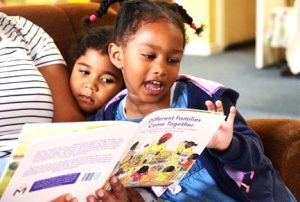
Mikhulu Trust’s vision is to support all parents to build nurturing stimulating relationships with their young children, For more than a decade, we have worked at the intersection of research, practice, and systems change to strengthen families during the most formative years of life — from birth to age six.
Mikhulu Trust has developed a set of programs that teach parents specific techniques for stimulating their children’s development through focused engagement with wordless picture books, our flagship program. We provide support to parents to help them engage in these meaningful interactions. The programme has demonstrated improvements in child cognitive development, child socio-emotional development, and has shown improvements in parents’ approaches to parenting, thereby facilitating the development of positive nurturing relationships.
The model for scale is based on building the capacity of non-profit and governmental organisations that work with parents and early child development centres. Mikhulu Trust trains and licenses these organisations to deliver their programme to caregivers, and provide ongoing mentorship, quality assurance and support.
Mikulu Trust is responding to needs for supporting parents of young children
- Positive early parent-child relationships directly impact lifelong development and education Children develop at an accelerated rate in their first few years of life, especially in the firstt 1000 days (up to age 2). Research shows us that this development can either be accelerated or hindered by external factors – the most important factor being the nature of the child’s relationship to their primary caregiver. When a child has even just one supportive primary relationship, they are able to grow and develop with more resilience, even when living under conditions of conflict or poverty. This influences their lifelong development, education, economic prospects and overall well-being. Where children’s relationship to their primary caregiver is unstable, inconsistent or insensitive, the child’s development is greatly compromised.
- Positive early parent-child relationships can reduce violence Research tells us that violent behaviour in adolescence and adulthood has its roots in early childhood. Three main parenting difficulties increases three associated child risk factors: (i) unresponsive/insensitive parenting leads to children being insecurely attached to the parent; (ii) harsh/inconsistent parenting leads to child behaviour problems; and (iii) poor cognitive stimulation and support leads to child cognitive problems (e.g., language delay and attentional problems) and educational failure. These three adverse early child outcomes are significant predictors of persistent child aggression and later violent behaviour. By targeting these parenting difficulties, we can reduce the child risk factors and potentially make a significant contribution to violence reduction in SA.
- Majority of young children stay home with a parent or caregiver In South Africa, only 35% of children are in formal or informal ECD services (centres, playgroups, daycare). Majority of children accessing these services are aged 4 – 5, while younger children who are experiencing their most accelerated phase of development are typically home with a parent.
4.No structured and systemic support for parents in South Africa While we know the critical role that parents play to raise healthy, loving children that are well equipped to do well in school, there is little to no structured support offered to parents. As an example, through our work, parents often share their insecurities – that they feel that their children’s education is best left to teachers who are more formally educated. Too often parents underestimate the necessary value they are able to add to their children’s lives, and there is little structured support that systemically promotes and supports them to do well for their children.
Mission
We aim to build an ecosystem of support for parents that enables them to develop positive and stimulating relationships with their young children by
-
- Developing, testing and researching supportive interventions that serve parents’ ECD and other needs
- Building capacity with government and other social services
- Producing quality resources
History
Mikhulu Trust, a non-profit organization based in Cape Town, South Africa, The Trust was started in 2015 officially registered as a non-profit company in South Africa in 2017, and as a public benefit organisation in 2018. Their passion and purpose lie in supporting parents to build positive, nurturing and stimulating relationships with their young children (aged 0 – 6).
Mikhulu Trust’s Supportive Book-Sharing program is one of four parenting programmes of the Parenting for lifelong Health (PLH) suite of programmes, endorsed by the World Health Organisation. The Mikhulu Trust conducts and supports research, develops training materials and other resources for parents and children, and trains, supports and licenses organisations to deliver programmes and interventions for parents of young children.
In addition to the Book-sharing for Families programmes, Mikhulu Trust expanded its work to provide a holistic basket of support services to parents, which includes running “drop-in” centres for parents to bond with their children. These Nurturing Family Centres offer psychosocial support, social work services, and an online helpline called Parentline SA.
Mikhulu Trust has trained over 50 organisations in South Africa to deliver the Book-Sharing Programme, runs the Nurturing Family Centre in 3 locations, offers psychosocial and social work services to all families in Cape Town and Stellenbosch. It also supports parents in all 9 provinces through Parentline South Africa. Mikhulu Trust is currently working with the Western Cape Department of Health and Western Cape Department of Social Development to integrate Book-Sharing into mainstream service delivery. Internationally, Mikhulu Trust has supported training and research into Book-Sharing in India, Tanzania, Zimbabwe, the United Kingdom, Cameroon, Lesotho, Brazil, the United States, and Italy.
Activities: Our Core Programs
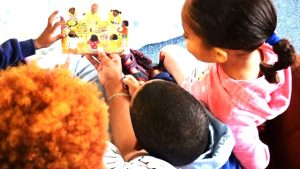
- Dialogic Book-Sharing for Families –an interactive, child-led reading method where adults and young children (usually under age 6) use picture books to hold a conversation rather than just reading text passively.
Our flagship intervention program, Dialogic Book-Sharing, is an evidence-based parenting approach endorsed as part of the Parenting for Lifelong Health suite of programs supported by the World Health Organization.
Dialogic book-sharing trains caregivers to:
-
- Follow the child’s lead
- Ask open-ended questions
- Encourage language and thinking
- Respond sensitively and warmly
This transforms book-sharing from passive reading into rich developmental dialogue.
1.Wordless Picture Books
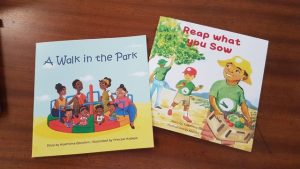
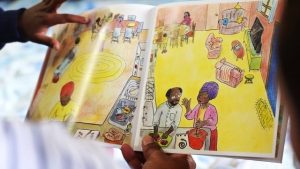
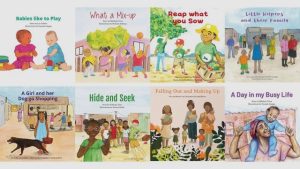
T enable inclusive implementation across South Africa’s multilingual and low-literacy contexts, Mikhulu develops its own wordless picture books. These beautifully designed books which feature multi-racial children,who represent diverse South African populations, are pictured in different scenarios that lend to description, questions, problem solving, and critical thinking between parent and child.
Since 2016, we have:
-
- Developed 22 locally produced wordless books
- Printed over 65,000 copies
- Distributed approximately 50,000 books nationally
These books are carefully aligned to developmental milestones and rooted in South African realities. They form part of our intellectual infrastructure, enabling scalable, low-cost delivery of high-quality early learning interactions.
- Fatherhood and Workplace Parenting Initiatives Through our “Time with Dad” (Ixesha lam noTata) program, we intentionally engage fathers and male caregivers — a critical but often neglected constituency in early childhood development. We have also piloted workplace-linked parenting initiatives, exploring how employers can support staff in strengthening relationships with their young children.
- Parentline SA Parentline SA is a WhatsApp-based parenting support platform offering accessible, culturally appropriate guidance to caregivers nationwide. Parentline extends support beyond in-person programs and strengthens continuity of care. It provides: light-touch parenting advice,, connections to local NGOs, and referrals to services
- Nurturing Family Centres Our Nurturing Family Centres provide safe, relational spaces where parents can: practice positive parent–child interaction receive psychosocial support, participate in guided learning sessions, access referral pathways.These centres operate as demonstration sites and hubs of relational learning within communities.
- Government Integration: Health and Social Development Mikhulu’s work is integrated into public systems rather than delivered in isolation. This systems alignment enables sustainable scale and ensures that investment leverages existing infrastructure.
In partnership with the Western Cape Department of Health, we have trained approximately 2,000 Community Health Workers to incorporate responsive caregiving and early stimulation into the First 1,000 Days during regular home visits.
- Social Work and Psychosocial Services
Recognising that many families face trauma and complex stressors, Mikhulu provides social work services that include:
-
- Individual and group counselling
- Screening and referral
- Support for high-risk families
- Capacity-building for partner organizations
This ensures that parenting support is not delivered in isolation from emotional wellbeing.
Audiences
Core / Primary Audience
Parents and Caregivers of Young Children (0–6 years) : The primary audience of the Mikhulu Child Development Trust is parents and caregivers of young children. The organisation focuses on empowering caregivers to support early learning and development, recognising them as a child’s first and most important teacher.
Young Children (0–6 years): While parents and caregivers are the direct audience, young children are the ultimate beneficiaries. Mikhulu’s programs aim to improve children’s language development, cognitive skills, and socio-emotional wellbeing.
Secondary Audience (Indirect Beneficiaries)
Community-Based Organisations (CBOs) and NGOs: Mikhulu partners with community organizations to implement its programs at scale. These organizations are trained to deliver parenting and early learning interventions.
Government Service Providers: This includes health workers, clinics, and public service platforms. Mikhulu collaborates with government departments to integrate early childhood support into existing systems.
ECD Practitioners and Facilitators: Early Childhood Development practitioners and community facilitators are trained to deliver Mikhulu’s book-sharing and parenting programmes.
Broader Ecosystem Audience
Researchers and Academic Institutions
Mikhulu works with research partners to ensure programs are evidence-based and impactful.
Policy-makers and the ECD Sector
The organization contributes to policy development and broader early childhood development strategies in South Africa.
Successful Impact
Mikhulu Trust was established in 2015 and formally registered as a non-profit company in 2017, with Public Benefit Organisation status obtained in 2018.
Since then, we have:
- Developed 22 wordless picture books
- Printed 65,000+ books
- Distributed approximately 50,000 copies
- Trained over 50 organisations nationally
- Reached families in all nine provinces in South Africa
- Trained approximately 2,000 Community Health Workers
- Worked with Western Cape Departments of Health and Social Development
- Collaborated internationally in India, Tanzania, Zimbabwe, the United Kingdom, Cameroon, Lesotho, Brazil, the United States, and Italy
- Been recognised as one of HundrED’s Top 100 Innovations in Education (2023)
Recommendation for Replication
- Package the Model into a Replication-Ready Product: Standardise the dialogic book-sharing model into toolkits, facilitator manuals, session guides, and digital resources to enable easy adoption.
- Scale Through Partners: Focus on training NGOs, government departments, and community organisations through a train-the-trainer and certification approach.
- Embed in Existing Systems: Integrate programmes into clinics, schools, libraries, and social services rather than creating standalone interventions.
- Use Low-Cost, High-Access Channels: Leverage WhatsApp, SMS, and audio-based content to reach low-literacy and low-resource communities.
- Strengthen Evidence for Scale: Develop policy briefs, cost-benefit analyses, and conduct replication pilots to support adoption.
- Create Clear Replication Models: Offer structured pathways such as NGO-led, government-integrated, digital-only, and workplace-based programmes.
- Invest in Brand and Advocacy: Promote book-sharing as a national parenting norm through campaigns and partnerships.
- Build Sustainable Funding Models: Explore government contracts, corporate partnerships, and licensing/social franchise approaches.
- Use a Phased Geographic Expansion Strategy: Start locally, expand provincially, and then regionally across Africa.
Example of collaboration: https://mikhulutrust.org/struisies-play-school-family-centre/
Contact Information
Organization: Mikhulu Child Development Trust (NPC)
Established: 2015 (registered as NPC in 2017; PBO in 2018)
Headquarters: Cape Town, South Africa
Contact: Karen Ross, CEO
Email address: Karen.ross@mikhulutrust.org
Mobile number: +27 83 460 3783
Link to Website: https://mikhulutrust.org
https://www.youtube.com/watch?v=LZLN2xiehy0